
Sound Generator
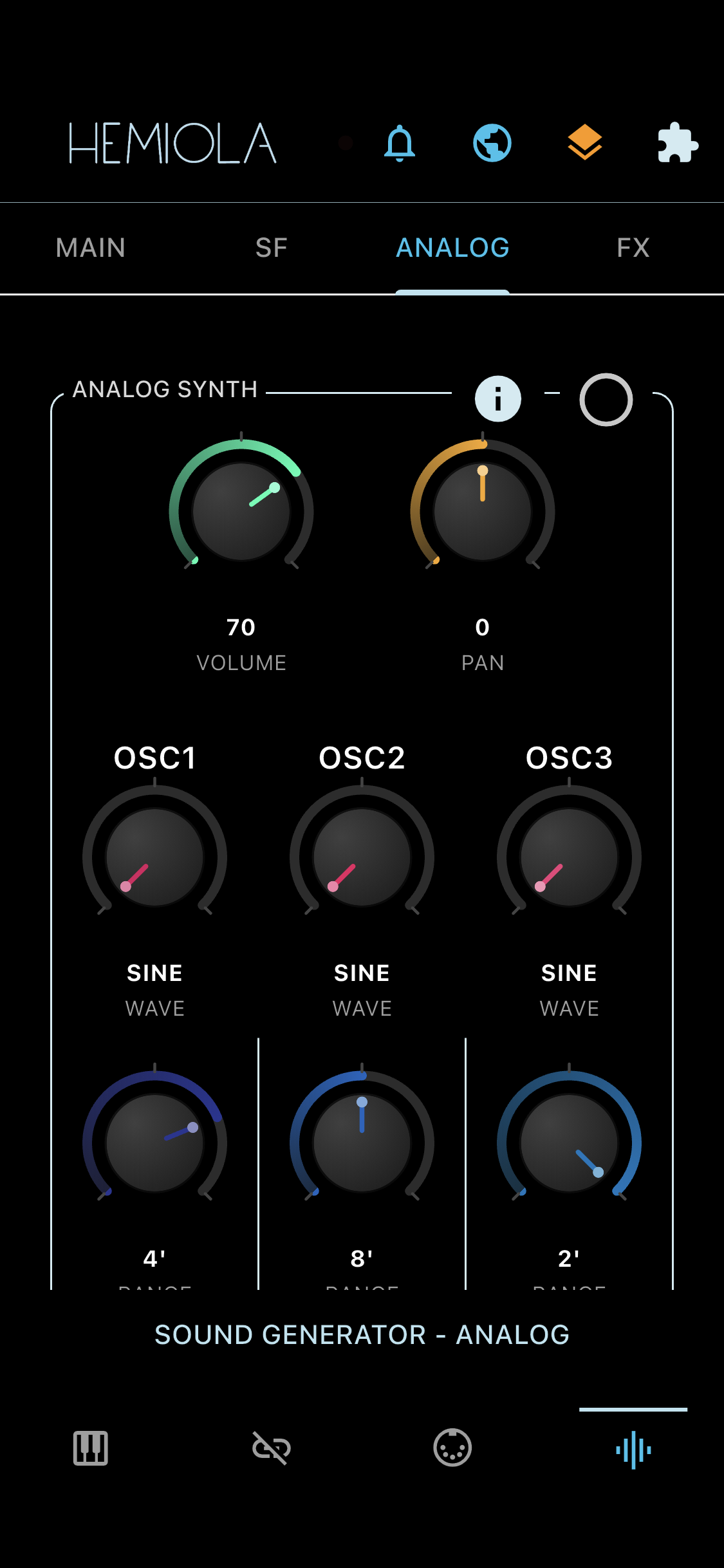
The Sound Generator includes two independent synthesizers: SoundFont and Analog. It responds to the piano keyboard, USB/BT MIDI devices, the virtual interface, and MIDI Network (iOS/macOS). Audio buffer size is configurable for minimum latency.
MAIN
- Master Volume: overall output level
- Channel Volume: volume sent via MIDI CC 7
- Pan: stereo panning (left ↔ right)
- Stereo mode: select mono or stereo output
A red dot appears on the top bar when clipping is detected. Lower the volume or activate the Limiter (Sound Effects) to resolve it.
PITCH
- Master Tuning: fine-tune in cents (−100 to +100); the A4 reference frequency is displayed in Hz
- Transpose: shift pitch by −12 to +12 semitones
- A4 switch: emits a reference A4 tone, affected by Transpose and Master Tuning
AUDIO OUTPUT
- Buffer Size: larger values reduce under-runs but increase latency
- AUTO: automatic buffer size management (recommended in most cases)
If the Sound Engine icon turns red, an audio buffer under-run occurred — increase the buffer size or enable AUTO. The section also shows a best-effort estimate of current audio latency and the sampling rate (set automatically by the audio engine).
SoundFont Synth
A sample-based synthesizer using the sf2 file format. Many free SoundFont collections are available online and can be uploaded to Hemiola.
- Volume: output level of the SoundFont module
- Pan: stereo panning of the SoundFont module
- Current: select the active SoundFont file (when multiple are loaded)
- Patch: select an instrument preset within the current SoundFont
- Custom: upload a local .sf2 file to Hemiola
Analog Synth
A digital emulation of a classic analog synthesizer, loosely inspired by the Minimoog Model D.
- Volume: output level of the Analog module
- Pan: stereo panning of the Analog module
Analog Oscillators
All three oscillators share the same set of parameters:
- Wave: waveform shape — Sine, Square, Sawtooth (×2), Triangle (×2)
- Range: base octave — 32', 16', 8', 4', or 2'
- Detune: fine-tune offset in cents (−100 to +100)
- Shift: semitone offset (−12 to +12)
- Volume: individual oscillator output level
Low Frequency Oscillator (LFO)
- Route: Vibrato, Frequency (pitch), LPF Cutoff, or Stereo spread
- Wave: waveform of the LFO (same types as oscillators)
- BPM: oscillation frequency
- Depth: amplitude range of the modulation
Low Pass Filter
- Cutoff: frequencies above this threshold are attenuated
- Emphasis: boosts frequencies around the cutoff frequency (resonance)
LPF Cutoff can be modulated by the LFO (Route: LPF Cutoff) or by MIDI CC.
Noise Generator
- White noise oscillator — useful for adding breath or air to a sound
- Volume: output level of the noise
Loudness Envelope (ADSR)
Controls the amplitude envelope of the Analog synth:
- Attack: time (ms) to reach full amplitude after note-on
- Decay: time (ms) to fall to the sustain level
- Sustain: amplitude level while key is held (per mille, 0–1000)
- Release: time (ms) to fade to silence after note-off